
Getting Things Done (GTD) is the personal productivity method created by David Allen. The idea is simple: get every commitment out of your head and into a trusted system, decide on the next action for each one, and review the system regularly so nothing slips. You can run GTD on paper, but a good app makes capturing, organizing and reviewing much faster.
This guide compares GTD apps that are still available today: who each one is for, which platforms it runs on, how it is priced, and where it falls short. For a hands-on example of the workflow, see how to use FocusCommit as a GTD system.
What is the best GTD app? The best GTD app depends on your devices and how strictly you follow David Allen’s method. OmniFocus and Things 3 are popular choices on Apple devices, Nirvana and FacileThings are built specifically around GTD, Todoist and TickTick work everywhere with free plans, and FocusCommit suits people who want GTD lists plus Kanban and Pomodoro.
GTD apps compared
| App | Best for | Platforms | Pricing model | Standout feature |
|---|---|---|---|---|
| FocusCommit | GTD plus Kanban and Pomodoro | iOS, Android, macOS, Windows | Free plan; Premium subscription or lifetime | Syncs with Microsoft To Do and Google Tasks |
| Todoist | Fast capture on every device | Web, Windows, Mac, Linux, iOS, Android, Apple Watch, Wear OS | Free plan; paid Pro and business plans | Natural-language task entry and filters |
| Toodledo | Tasks plus goals, habits and notes | Web, iOS, Android | Freemium | Goals, habits, outlines and custom lists |
| Remember the Milk | Reminders and long-time cross-platform use | Web, Windows, Mac, Linux, iOS, Android, Apple Watch | Freemium (Pro upgrade) | Location- and time-based reminders |
| FacileThings | Following GTD step by step | Web, iOS, Android | Subscription with 30-day free trial | GTD workflow built in, including weekly review |
| Things 3 | A polished app for Apple users | Mac, iPhone, iPad, Apple Watch, Vision Pro | One-time purchase per platform | Clean design; two Apple Design Awards |
| 2Do | Power users on Apple devices | Mac, iPhone, iPad | One-time purchase on Mac; in-app purchases on iOS | Flexible sync options and smart lists |
| Microsoft To Do | Microsoft 365 and Outlook users | Windows, iOS, Android, web | Free | Works with Outlook tasks |
| Nirvana | Classic GTD lists without clutter | Web, Mac, Windows, iPhone, iPad, Android | Freemium (Pro) | Contexts plus time and energy filters |
| TickTick | A capable free plan | iOS, Android, Mac, Windows, Linux, web | Freemium | Built-in Pomodoro timer and habit tracker |
| Everdo | Privacy and offline use | Windows, Mac, Linux, iOS, Android | Free tier; one-time Pro; optional sync subscription | Offline-first with end-to-end encrypted sync |
| OmniFocus 4 | Complex projects on Apple devices | Mac, iPhone, iPad, Apple Watch, Vision Pro, web | Subscription or one-time purchase; 14-day trial | Custom perspectives and built-in review |
| Firetask | GTD with Kanban boards on Apple devices | iPhone, iPad, Mac | Free one-month trial, then paid | Kanban boards, Waiting For list and Pomodoro timer |
What is GTD software?
GTD software is a task manager set up to support David Allen’s workflow. GTD has five steps: capture everything that has your attention, clarify what each item means and what the next action is, organize the results into the right lists, reflect on the system in a regular weekly review, and engage by doing the work.
Almost every GTD app is built around a task list with projects, due dates and reminders. Many also connect to tools you already use, such as Google Calendar, your email or chat apps, so you can turn messages into tasks without retyping them.
What should you look for in a Getting Things Done app?
Fast capture: adding a task should take seconds, from your phone, your computer or your email, so ideas land in an inbox instead of staying in your head.
Lists that match GTD: you need projects, next actions and contexts (or tags), plus places for “waiting for” and “someday/maybe” items. Some apps have these built in; others let you build them with tags and filters.
Support for the weekly review: the review is what keeps a GTD system trustworthy. Apps with a built-in review, or views that show stale projects, make it easier to keep up the habit.
Integrations: look for connections to your calendar, email and chat tools, so time-specific actions go on your calendar and everything else stays on your lists.
Collaboration, if you need it: if you delegate work, choose an app that lets you share and assign tasks and track what you are waiting for from others.
The right platforms: your system only works if it is with you everywhere. Check that the app runs on every device you use before you commit.
The best GTD apps
FocusCommit: best for combining GTD with Kanban and Pomodoro
FocusCommit is for people who want to organize tasks the GTD way and then actually get them done with focused work sessions. It runs on iOS, Android, macOS and Windows. (Full disclosure: FocusCommit is our app.)
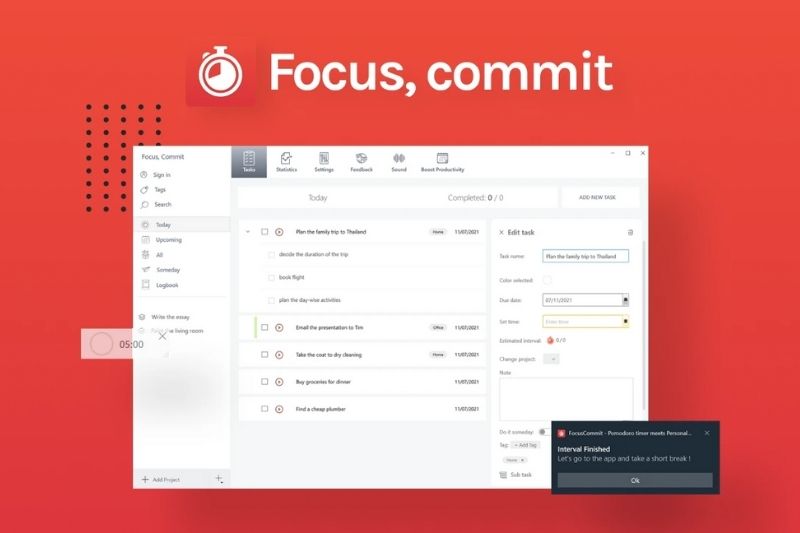
FocusCommit combines a GTD workflow with a Kanban board and a Pomodoro timer. It syncs with Microsoft To Do and Google Tasks, so you can keep using the lists you already have. White noise helps you concentrate, and statistics show how much focused time you put in.
Pros:
- GTD lists, Kanban board and Pomodoro timer in one app
- Works with Microsoft To Do and Google Tasks
- Native apps for iOS, Android, macOS and Windows
Cons:
- The free plan limits the number of tasks
- Not built for team collaboration
Pricing: free plan with a task limit. Premium costs $14.99 a year or $29.99 for a lifetime license on the web, or $1.99 a month in the iOS, Android, Windows and Mac apps (as of October 2026). Download FocusCommit.
Todoist: best for fast capture on every device
Todoist suits people who want a quick, clean to-do list that runs everywhere and can be shaped into a GTD system with projects, labels and filters.
Todoist’s standout features:
- Natural-language input: type “Call Anna every Monday” and Todoist sets the date and recurrence for you.
- Filters and views: Today and Upcoming views, plus custom filters, surface the next actions that matter.
- Separate spaces: keep personal tasks apart from shared team projects.
- Todoist Assist, an AI helper for planning tasks, and dozens of ready-made templates.
Todoist’s limitations: it isn’t GTD-specific, so you build contexts and a weekly review yourself, and some features require a paid plan.
Platforms: web, Windows, Mac, Linux, iPhone, iPad, Android, Apple Watch and Wear OS. Pricing model: free plan, with paid Pro and business plans.
Toodledo: best for goals and habit tracking alongside tasks
Toodledo is for people who want more than a task list: it combines tasks with goals, habits, notes and outlines in one account.
Toodledo’s standout features:
- Highly customizable tasks with folders, tags, subtasks, reminders and time tracking.
- Goals and habits with progress charts, so your next actions connect to bigger objectives.
- Outlines, formatted notes and custom multi-column lists.
- Task sharing and assignment for working with others.
Toodledo’s drawbacks: the interface looks less modern than most apps on this list.
Platforms: web, iOS and Android. Pricing model: free account, with optional paid upgrades.
Remember the Milk: best for reminders across every platform
Remember the Milk is a long-running to-do app for people who want dependable reminders for everything from errands to work projects, on almost any device.
Remember the Milk’s standout features:
- Time- and location-based reminders, so the shopping list appears when you’re near the store.
- Sharing and delegating tasks to other people.
- Integrations with other apps and services, plus a beta feature that lets you manage tasks by asking an AI assistant.
Remember the Milk’s drawbacks: getting the most out of it takes some setup, which can feel like a learning curve if you want something very simple.
Platforms: web, Windows, Mac, Linux, iPhone, iPad, Android and Apple Watch. Pricing model: free, with a paid Pro upgrade.
FacileThings: best for following GTD step by step
FacileThings is for people who want an app that teaches and enforces the GTD workflow rather than leaving the setup to them.
The GTD workflow is built into the app: an inbox for capture, step-by-step processing of each item, context-based lists, project planning (with AI assistance), a mind sweep tool and a built-in weekly review. It connects to Google and Outlook calendars and lets you delegate tasks to collaborators.
Once you’ve decided whether an item is actionable, FacileThings lets you:
- Delegate it.
- Add it to a list or schedule it.
- File it as reference.
- Move it to the “Someday” list.
- Delete it.
Pros:
- Designed specifically for GTD
- Guided, step-by-step workflow
- Built-in weekly review
Cons:
- No free plan after the trial
- Less flexible if you don’t want to follow GTD by the book
Platforms: web, iOS and Android. Pricing model: subscription, with a 30-day free trial and no credit card required.

Things 3: best GTD app for Mac and iPhone users who value design
Things 3 is for Apple users who want a beautiful, easy-to-use task manager and don’t need to share tasks with a team. It has won two Apple Design Awards.
Things organizes tasks into projects and areas, with daily planning, tags, Markdown notes, keyboard shortcuts and Shortcuts automation. Your tasks sync across your Apple devices.
Pros:
- Syncs across Mac, iPhone, iPad, Apple Watch and Vision Pro
- Clean, intuitive interface
- One-time purchase rather than a subscription
Cons:
- Apple devices only
- Each platform is a separate purchase; only the Mac version has a free trial
- No collaboration features for teams
2Do: best for power users on Apple devices
2Do is for people who want deep customization and flexible sync on Mac, iPhone and iPad.
2Do parses natural-language input for dates, times and priorities, and offers smart lists (saved searches), focus filtering, password-protected lists, location-based reminders, Markdown notes and an email address for turning emails into tasks. You can sync through iCloud, Dropbox, Apple Reminders, Todoist, CalDAV or your own server, and recent versions add automation through AI assistants.
Pros:
- Outstanding customization and flexibility
- Handles simple tasks, checklists and projects
- Many sync options
Cons:
- Steeper learning curve than simpler apps
- No built-in team collaboration
Pricing model: one-time purchase on Mac (with a 14-day free trial, also available through Setapp); the iOS app offers in-app purchases.
Microsoft To Do: best free GTD app for Microsoft 365 users
Microsoft To Do is a free to-do list for people who already live in Outlook and Microsoft 365. It runs on Windows, iOS, Android and the web.
You can break tasks into steps, add due dates and reminders, and share lists with family or colleagues. Because it works with Outlook tasks, emails you need to act on can become tasks without retyping. If you want a Kanban board or a Pomodoro timer on top of your Microsoft To Do lists, FocusCommit can sync with it; see how to use a Kanban board for Microsoft To Do.
Pros:
- Free with a Microsoft account
- Works with Outlook and the rest of Microsoft 365
- Shared lists for collaboration
Cons:
- Not designed specifically for GTD; contexts and a weekly review are up to you
- Fewer customization options than dedicated GTD apps
Nirvana: best for classic GTD lists without clutter
Nirvana is for people who want an app inspired directly by GTD that stays simple. It runs in the browser and on Mac, Windows, iPhone, iPad and Android.
Nirvana’s standout features:
- Built around GTD: an inbox for capture and a focus on the next action for each project.
- Contexts and tags such as @Home or @Work, plus filters for time and energy, so you can pick a task that fits the moment.
- A minimal design that keeps the focus on your lists.
Nirvana’s drawbacks: advanced users may find it too basic.
Pricing model: free plan, with a paid Pro plan.
TickTick: best free GTD app
TickTick is for people who want a full-featured task manager with a generous free plan and apps for every major platform: iOS, Android, Mac, Windows, Linux and the web.
Alongside lists, due dates, reminders and recurring tasks, TickTick includes a Pomodoro focus timer, a habit tracker, calendar views, an Eisenhower matrix and Kanban boards.
Pros:
- A complete task management toolkit
- A free plan you can use long term
- Extras such as the Pomodoro timer and habit tracker
Cons:
- Adaptable for GTD, but not GTD-specific
- Some features require Premium
Pricing model: free plan, with a paid Premium subscription.
Everdo: best for privacy and offline use
Everdo is for GTD practitioners who want their data to stay private and their app to work without an internet connection. It runs on Windows, Mac, Linux, Android and iOS.
Everdo’s standout features:
- Built on GTD, with projects, next actions, areas of responsibility, contexts and focus filtering.
- Offline-first: it works without internet, and sync is optional.
- Sync choices: end-to-end encrypted cloud sync or sync over your local network.
Everdo’s drawbacks: the interface favors information density over looks, and the free tier limits how many projects and areas you can create.
Pricing model: free tier; Pro is a one-time purchase, with encrypted cloud sync as an optional subscription.
OmniFocus 4: best for complex projects on Apple devices
OmniFocus is for Apple users with many projects who want fine control over how they view and review their work. The current version is OmniFocus 4.
Highlights:
- A quick-entry inbox with keyboard shortcuts for capture.
- Projects, tags and a Forecast view of upcoming work.
- Custom Perspectives that show exactly the tasks you want to see.
- A built-in Review that walks you through your projects, in the spirit of the GTD weekly review.
Limitations: it is built for Apple devices. There is a web version, but no native app for Windows or Android.
Platforms: Mac, iPhone, iPad, Apple Watch, Apple Vision Pro and the web. Pricing model: subscription or one-time purchase, with a 14-day free trial.
Firetask: best for GTD with Kanban boards on Apple devices
Firetask is for Apple users who like GTD but also want visual boards. The current version is Firetask 5, for iPhone, iPad and Mac.
Firetask follows the GTD steps of capture, clarify, organize and reflect. You collect tasks in an inbox, organize them into projects, portfolios and categories, and track delegated work in a Waiting For list. Kanban boards with drag and drop, monthly and weekly calendar views, templates and a built-in Pomodoro timer round it out, and everything syncs through iCloud.
Key features:
- Kanban boards for visual task management
- Inbox and Waiting For lists
- Calendar views and project templates
- Pomodoro timer
- Global keyboard shortcuts and widgets
Pricing model: free one-month trial, then paid through the App Store.
Other tools that can support a GTD system
The apps below aren’t built around personal GTD, but teams often use them to manage shared projects, and Evernote is a common home for GTD reference material.
ClickUp
ClickUp is an all-in-one work platform for teams that want tasks, docs and chat in one place. It runs on the web, Windows, Mac, Linux, iOS and Android.
It scales from personal task lists to complex projects, with list, board and Gantt views, docs and whiteboards, time tracking, automations and an AI assistant. That flexibility means you can model GTD lists in it, but the setup is up to you. Pricing model: free forever plan, with paid plans for more features.
Nozbe
Nozbe is a task and project manager for small teams. Earlier versions of this article covered Nozbe Personal; that product is no longer offered, and today’s Nozbe is aimed at teams, with the older Nozbe Classic still available to existing users.
Key features include projects with deadlines and reminders, an Incoming view for new tasks, project templates, email-to-task conversion and time tracking. It runs on the web, Mac, Windows, iOS and Android. Pricing model: free plan for up to 3 users and 3 active projects, with paid per-user plans.
nTask
nTask is a project management tool for teams that need task lists alongside meetings, issue tracking and timesheets. It runs on the web, iOS and Android.
Key features:
- Kanban boards and Gantt charts
- Task status, priorities and team assignments
- Time tracking and timesheets
- Meeting management with calendar integration
- Issue and risk tracking
- Integrations with other apps through Zapier
Pricing model: free Basic plan for small teams, with paid plans that include a 7-day free trial.
ProofHub
ProofHub is a cloud-based project management and collaboration platform for teams that want one flat price instead of per-user fees.
It offers tasks, Gantt charts, Kanban boards and calendars, plus discussions, chat, file sharing, online proofing and time tracking. Teams can build custom workflows to match how they process work. Pricing model: flat-fee subscription with unlimited users and a 14-day free trial; there is no free plan.
Hitask
Hitask is a task manager for small teams, such as agencies and startups, that want shared tasks and a shared calendar. It runs on the web, iPhone, iPad and Android, with a Chrome extension.
Key features:
- Projects, tasks and sub-tasks
- Shared team calendar with Outlook and Google Calendar sync
- Recurring tasks
- File storage and attachments
- Time tracking with reports
- Team messaging
Pricing model: free sign-up, with paid plans for teams.
Evernote
Evernote is a note-taking app that many GTD users rely on for reference material: notes, documents and web pages you want to keep but don’t need to act on.
It runs on Windows, Mac, iOS, Android and the web, with a Web Clipper for Chrome, Firefox and Safari. Notebooks, templates, tasks, document scanning and calendar integration let you keep project notes next to related to-dos. It isn’t designed for GTD, so most people pair it with a dedicated task manager. Pricing model: free plan, with paid plans.
How to choose your GTD app
Start with your devices. If you only use Apple hardware, Things 3, OmniFocus, 2Do and Firetask are all strong options. If you switch between Windows, Android and Apple devices, look at Todoist, TickTick, Nirvana, Everdo, Remember the Milk or FocusCommit. If you want the app to guide you through GTD, try FacileThings.
Then try one for two weeks, including at least one weekly review. The best GTD app is the one you trust enough to empty your head into.
Frequently asked questions
What is a GTD app?
A GTD app is a task manager that supports David Allen’s Getting Things Done method: capturing everything in an inbox, deciding the next action, organizing tasks into projects and contexts, and reviewing your lists every week.
What features should a GTD app have?
Look for fast capture into an inbox, projects and next actions, contexts or tags, lists for waiting-for and someday/maybe items, support for a weekly review, calendar integration, and sync across every device you use.
Is there a free GTD app?
Microsoft To Do is free. Todoist, TickTick, Nirvana, Everdo, Toodledo, Remember the Milk and FocusCommit all have free plans, with paid upgrades for more features.
Which GTD app works on both iPhone and Windows?
Todoist, TickTick, Nirvana, Everdo, Remember the Milk, Microsoft To Do and FocusCommit have apps for both iPhone and Windows. Things 3 and OmniFocus have no Windows app, although OmniFocus can be used in a web browser.
Do I need a dedicated GTD app to practice GTD?
No. GTD is a method, not a piece of software, and it can run on paper or any list app you trust. A GTD-focused app such as FacileThings, Nirvana or OmniFocus simply makes capturing and the weekly review easier.
Can I combine GTD with the Pomodoro Technique?
Yes. GTD tells you what to work on next, and Pomodoro sessions help you focus on it. FocusCommit, TickTick and Firetask include a Pomodoro timer alongside their task lists.
